What’s the Core Difference Between B2B and B2C SaaS Marketing?
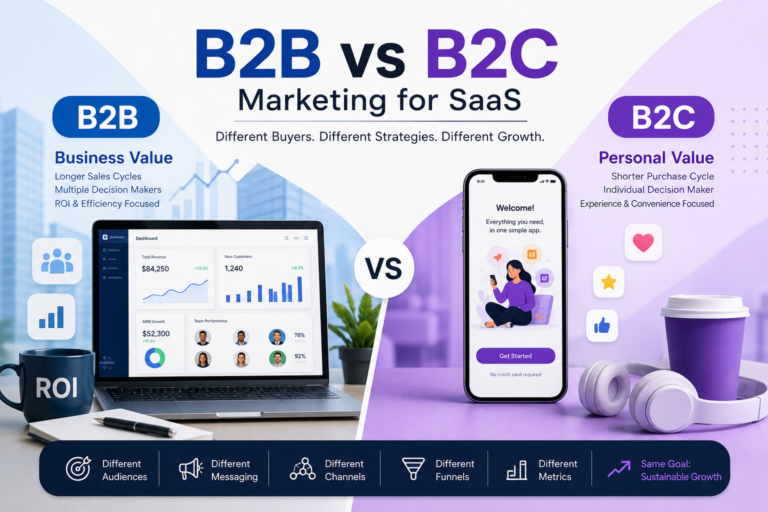
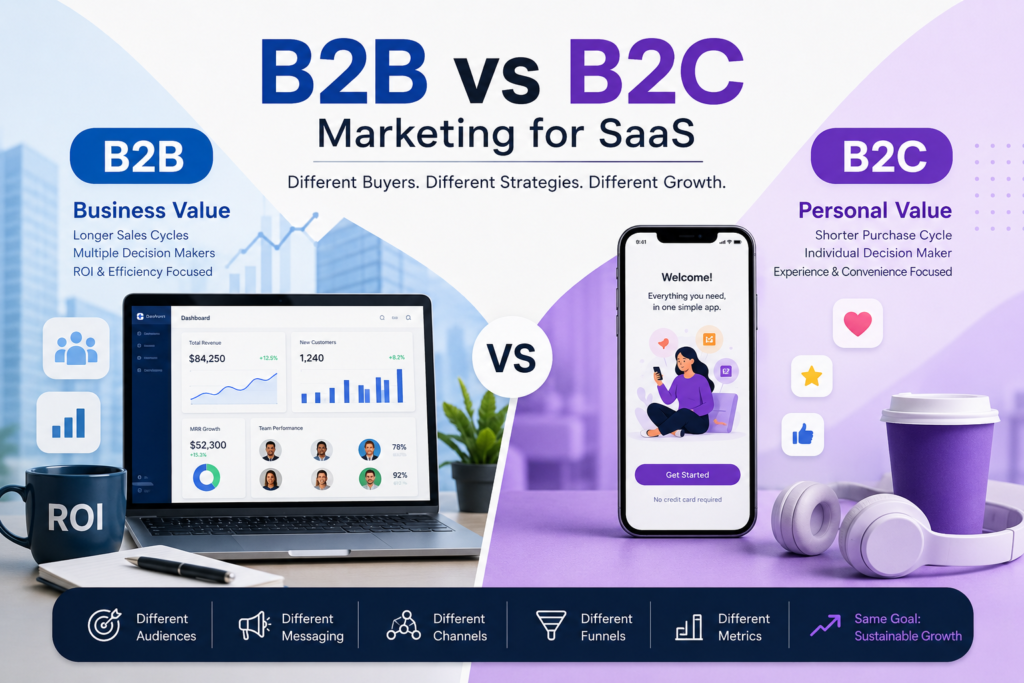
B2B and B2C SaaS companies operate in fundamentally different markets, and their marketing strategies must reflect these differences. B2B SaaS marketing focuses on building long-term relationships with multiple decision-makers over extended sales cycles (84-104 days on average), while B2C SaaS prioritizes quick conversions from individual consumers within days or hours. This single distinction cascades through every aspect of marketing strategy—from channel selection to messaging tone to customer acquisition costs.
While both models deliver software via cloud infrastructure with subscription-based pricing, the buyer personas, decision-making processes, and value propositions they pursue are poles apart. Understanding these differences is the foundation for building a winning marketing strategy in the SaaS space.
B2B SaaS Marketing vs B2C SaaS Marketing: Side-by-Side Comparison
| Aspect | B2B SaaS | B2C SaaS |
|---|---|---|
| Primary Buyer | Decision-makers, managers, executives | Individual consumers |
| Sales Cycle | 84-104 days (enterprise) / 30-60 days (SMB) | 1-7 days (often same-day) |
| Number of Stakeholders | 5-10+ decision-makers | 1-2 decision-makers |
| Primary Value Metric | ROI, efficiency, revenue impact | Personal benefit, ease of use |
| Key Channels | LinkedIn, Google Ads, webinars, content marketing | Instagram, Facebook, TikTok, YouTube |
| Content Type | Whitepapers, case studies, webinars, research | Videos, social posts, user-generated content |
| Marketing Message | Data-driven, professional, formal | Emotional, visual, conversational |
| Churn Rate | 4.67% annually | 5.06% annually |
| Customer Acquisition Focus | Lead generation + relationship building | Brand awareness + viral growth |
| Onboarding | High-touch with account managers | Self-serve, automated, quick-start |
| Support Model | White-glove support, quarterly business reviews | Self-service FAQs, chatbots, community |
| Average Contract Value (ACV) | $10,000 – $500,000+ | $10 – $500 |
What is B2B SaaS Marketing?
B2B SaaS marketing is the practice of promoting cloud-based software solutions that help businesses improve operations, increase efficiency, or drive revenue. These products address specific business challenges—from customer relationship management (CRM) to enterprise resource planning (ERP) to human resources management.
Key Characteristics of B2B SaaS
Complex buying committee: Purchasing decisions involve IT managers, finance officers, department heads, and C-suite executives. Each stakeholder has different concerns—IT worries about security and integration, finance cares about ROI and cost, and department heads focus on usability and productivity gains.
Longer evaluation periods: Prospects research extensively, request demos, read case studies, and compare competitors. According to Forrester research, B2B buyers conduct an average of 12-15 online research sessions before contacting a sales representative.
Relationship-driven sales: Success depends on building trust with multiple stakeholders over months. CSMs (Customer Success Managers) often manage relationships worth hundreds of thousands of dollars.
Measurable business outcomes: Marketing and sales messaging must quantify value—not as features, but as financial impact. Example: “Reduce QA time by 30%, saving $250k annually” rather than “powerful testing tools.”
Popular B2B SaaS Examples
- Salesforce (CRM for enterprise sales teams)
- HubSpot (inbound marketing and CRM)
- Slack (team communication for enterprises)
- Monday.com (project management for businesses)
- Zapier (workflow automation)
What is B2C SaaS Marketing?
B2C SaaS marketing is the practice of promoting cloud-based applications directly to individual consumers for personal use—whether entertainment, productivity, fitness, education, or lifestyle enhancement. These products live in consumers’ pockets and desktops, used daily by individuals making personal purchasing decisions.
Key Characteristics of B2C SaaS
Individual decision-makers: One person decides to try and buy. Purchases often happen on impulse or after minimal research, driven by emotional appeal and user experience rather than business logic.
Rapid conversion cycles: The time between first exposure and purchase can be minutes or hours. A compelling social media post or app review can trigger an immediate signup.
Viral and community-driven growth: Network effects matter enormously. If your friends use the app, you’re more likely to try it. Word-of-mouth and social sharing are primary acquisition channels.
User experience is paramount: Since the buyer is also the end-user, interface design, learning curve, and daily utility drive retention far more than they do in B2B.
Emotional and aspirational messaging: Messaging focuses on how the product makes life easier, better, or more enjoyable—not on calculating ROI.
Popular B2C SaaS Examples
- Spotify (music streaming)
- Netflix (entertainment streaming)
- Grammarly (writing assistance)
- Canva (design for non-designers)
- Duolingo (language learning)
- Notion (personal productivity, though it also targets teams)
Key Marketing Strategy Differences
1. Messaging Tone and Language
B2B marketing uses formal, data-driven language that demonstrates clear business value. Messaging emphasizes:
- Quantified outcomes (“increase productivity by 40%”)
- Risk mitigation (“SOC 2 compliant, enterprise-grade security”)
- ROI calculations and payback periods
- Thought leadership and industry expertise
Example B2B headline: “Reduce customer acquisition cost by 35% with predictive lead scoring”
B2C marketing adopts a conversational, aspirational tone. Messaging emphasizes:
- Personal transformation or convenience
- Emotional benefits (“save 10 hours weekly” = more time with family)
- Fun and delight in the product experience
- Community and belonging
Example B2C headline: “Finally understand what you’re reading—even in challenging languages”
2. Content Formats and Strategy
| B2B Content | B2C Content |
|---|---|
| In-depth blog posts (2,000-5,000 words) | Short-form video (15-60 seconds) |
| Whitepapers and original research | User-generated content |
| Webinars and virtual events | Memes and trending audio |
| Case studies with quantified results | Influencer partnerships |
| Email nurture sequences | Social media carousels |
| Product demos and technical guides | Testimonials and reviews |
| LinkedIn articles and newsletters | TikTok, Instagram Reels, YouTube Shorts |
B2B content marketing aims to establish authority and generate qualified leads. According to HubSpot, 73% of B2B companies that outperform revenue targets use content marketing as a core strategy. These companies publish long-form, educational content that answers the complex questions buyers ask during research.
B2C content marketing prioritizes reach and engagement. Shorter formats dominate because attention spans are limited and platforms reward viral potential. The goal is brand awareness and emotional connection, often leading to immediate signup.
3. Paid Advertising Strategies
B2B SaaS companies typically invest in:
- LinkedIn Ads: 94% of B2B marketers use LinkedIn for content distribution. Minimum viable spend is $3,000-5,000/month for meaningful data.
- Google Search Ads: Capture high-intent searches like “[product category] for [business type]”
- Account-Based Marketing (ABM): 70%+ of B2B companies with enterprise sales have piloted ABM programs, targeting specific high-value accounts with personalized campaigns
- Retargeting: Reaching people who visited your website across LinkedIn and Google
B2C SaaS companies typically invest in:
- Instagram & Facebook Ads: Visual storytelling with carousel ads, video ads, and shopping features
- TikTok Ads: Reaching younger demographics with native, authentic content
- YouTube Pre-roll: Brand awareness through short video ads
- Google App Campaigns: Direct installs and onboarding optimization
Sales Cycles: The 84-Day Difference
The most dramatic difference between B2B and B2C marketing is sales cycle length.
B2B SaaS Sales Cycle (Average 84-104 days for enterprise)
Week 1: Discovery & awareness
↓
Week 2-3: Research & demo request
↓
Week 4-6: Product trial & evaluation
↓
Week 7-10: Internal stakeholder reviews & procurement
↓
Week 11-15: Contract negotiation
↓
Week 16+: Implementation & onboarding
This extended timeline means B2B marketing must nurture leads over months with consistent touchpoints:
- Educate prospects through content
- Build trust through case studies and social proof
- Support stakeholder alignment through tailored messaging per buyer persona
- Address objections proactively (security concerns, integration challenges, ROI questions)
B2C SaaS sales cycle (Average 1-7 days):
Hour 1: Social ad or app store discovery
↓
Hour 2-4: Signup and onboarding
↓
Hour 5-24: Trial usage
↓
Day 2-7: Convert to paid or churn
B2C marketing must compress the evaluation period drastically:
- Remove friction from signup (single sign-on, quick profile creation)
- Deliver immediate value in the first session
- Use push notifications and email to nudge conversion
- Optimize the trial-to-paid conversion funnel ruthlessly
Marketing Channels: Where to Find Your Audience
B2B SaaS: Primary Channels
1. LinkedIn (Primary Channel)
- Where decision-makers spend professional time researching solutions
- 94% of B2B marketers use LinkedIn for content distribution
- Effective tactics: Employee advocacy, long-form posts, LinkedIn ads, newsletter sponsorships
- Best for: Lead generation, brand awareness, thought leadership
2. Google Ads (Search & Display)
- Capture high-intent searches: “best CRM for sales teams,” “project management software comparison”
- Budget allocation: $8,000-25,000/month for growth-stage companies
- Best for: Demand capture, direct lead generation
3. Content Marketing & Organic Search (SEO)
- Blog posts ranking for “[product category] for [use case]” queries
- Webinar and resource center optimization
- 67% advantage in lead generation for companies with active blogs
- Best for: Long-term inbound pipeline, thought leadership
4. Email Marketing
- Nurture sequences targeting identified leads
- Personalized sequences segmented by buyer persona and company size
- Best for: Lead nurturing, retention, expansion
5. Webinars and Virtual Events
- Product demos, industry roundtables, educational sessions
- Lead capture mechanism with follow-up workflows
- Best for: High-touch prospecting, trial-to-customer conversion
6. Account-Based Marketing (ABM)
- Personalized campaigns targeting specific high-value accounts
- Coordinated multi-channel touches (LinkedIn ads, direct mail, personalized emails)
- Best for: Enterprise sales, closing high-ACV deals
B2C SaaS: Primary Channels
1. Social Media (Instagram, TikTok, Facebook)
- Visual storytelling and product demonstration
- 51%+ of B2C marketers consider Instagram and Facebook vital for audience connection
- Effective tactics: Reels, stories, carousel posts, influencer collaborations
- Best for: Brand awareness, customer acquisition, viral growth
2. YouTube
- Tutorial videos, product demos, customer testimonials
- YouTube ads for reach and app installs
- Organic channel for building authority and discoverability
- Best for: Brand awareness, conversion, engagement
3. Influencer Marketing
- Micro and macro-influencers reviewing/demonstrating the product
- Affiliate partnerships with aligned creators
- Best for: Reach, credibility, new audience acquisition
4. App Store Optimization (ASO)
- App description, screenshots, reviews optimization
- Keyword strategy for app store search
- Best for: Organic installs, retention
5. Paid Social (Facebook, Instagram, TikTok Ads)
- Broad audience targeting based on interests and behavior
- Retargeting website visitors and app users
- Best for: Conversions, user acquisition, CAC optimization
6. Community & Viral Marketing
- Reddit, Discord, Slack communities
- User-generated content campaigns
- Referral programs with incentives
- Best for: Organic growth, retention, brand loyalty
Customer Onboarding: High-Touch vs Self-Service
How you bring customers into your product differs dramatically.
B2B SaaS Onboarding (High-Touch)
- Dedicated onboarding manager walks the customer through implementation
- Multi-week training programs covering setup, integration, and optimization
- Quarterly business reviews tracking progress against KPIs
- Customization and configuration to fit unique business processes
- Security, compliance, and integration reviews involving IT and security teams
Goal: Ensure successful adoption, demonstrate ROI, and establish long-term relationship.
B2C SaaS Onboarding (Self-Service)
- In-app walkthroughs guide users through core features in 2-5 minutes
- Automated email sequences triggered by user actions
- Contextual help tooltips appear when users need them
- Video tutorials for advanced features
- Frictionless signup (one-click sign-in, minimal profile data)
Goal: Reduce time-to-value to minutes, minimize support requests, maximize trial-to-paid conversion.
Key Metrics: What to Track
B2B SaaS Metrics (Focus: Revenue & Retention)
| Metric | Target Range | Why It Matters |
|---|---|---|
| Marketing Qualified Leads (MQLs) | 100+ per month (varies by ACV) | Volume indicator of demand generation |
| Sales Qualified Leads (SQLs) | 10-20% of MQLs | Quality of lead scoring |
| CAC Payback Period | 9-12 months | Sustainability of acquisition spend |
| Customer Acquisition Cost (CAC) | 1-3x first-year contract value | Unit economics of growth |
| Annual Recurring Revenue (ARR) | Month-over-month growth | Primary revenue metric |
| Net Revenue Retention (NRR) | 110%+ (healthy), 140%+ (excellent) | Expansion revenue from existing customers |
| Churn Rate | < 5% annually | Customer retention health |
| Sales Cycle Length | Tracked per segment | Predictability of revenue recognition |
B2C SaaS Metrics (Focus: Growth & Retention)
| Metric | Target Range | Why It Matters |
|---|---|---|
| Monthly Recurring Revenue (MRR) | Month-over-month growth | Primary revenue metric |
| Customer Acquisition Cost (CAC) | < 3-month LTV | Unit economics of paid channels |
| Lifetime Value (LTV) | 3-5x CAC minimum | Long-term profitability |
| Trial-to-Paid Conversion Rate | 3-10% | Funnel efficiency |
| Churn Rate | 5-8% monthly | Customer retention health |
| Daily/Monthly Active Users (DAU/MAU) | Upward trajectory | Engagement and stickiness |
| Blended CAC | Across all channels | True acquisition cost |
| Payback Period | < 12 months | How quickly revenue recovers ad spend |
The Hybrid Model: When B2B and B2C Collide
Some of the most successful SaaS companies operate in both markets simultaneously. This “prosumer” or hybrid model creates unique opportunities and challenges.
How Successful Companies Do It
Grammarly
- B2C: Millions of individual users via free browser extension
- B2B: Enterprise teams and companies through separate sales channel
- Strategy: Consumer trust becomes a sales asset for enterprise deals
Slack
- B2C: Individuals download and try Slack personally
- B2B: Teams adopt, IT standardizes on enterprise plan
- Strategy: Bottom-up product-led growth feeds enterprise pipeline
Notion
- B2C: Started as personal productivity app
- B2B: Added team workspaces and enterprise controls
- Strategy: Two distinct pricing tiers serve both audiences simultaneously
Dropbox
- B2C: Free personal storage drives adoption and brand trust
- B2B: Dropbox Business plans monetize teams and enterprises
- Strategy: Personal users become advocates inside their companies
Zoom
- B2C: Free tier with 40-minute limit reaches consumers
- B2B: Enterprise plans with admin controls, SSO, compliance
- Strategy: Same product, two completely different go-to-market motions
The Hybrid Marketing Playbook
The critical insight: Hybrid SaaS companies need two separate marketing playbooks that share a brand identity but use distinct messaging, channels, and funnels.
Separate strategies for each segment:
- Different landing pages and messaging per audience
- Distinct paid advertising channels (LinkedIn for B2B, Instagram/TikTok for B2C)
- Segmented email lists and nurture sequences
- Separate sales motions (self-serve for B2C, account-based for B2B)
Unified brand identity:
- Consistent visual design and brand voice
- Shared company values and mission
- Interconnected product that works for both segments
How Marketing Automation Differs
Both B2B and B2C SaaS use marketing automation, but the strategies diverge significantly.
B2B Marketing Automation
Focus: Lead nurturing and relationship building over time
Effective tactics:
- Multi-step email workflows triggered by specific actions (downloaded whitepaper → email sequence)
- Lead scoring that identifies MQLs ready for sales
- Account-based targeting using company data and firmographic information
- CRM integration to align marketing and sales on lead progression
- Webinar automation with follow-up sequences tied to attendance and engagement
Tools: HubSpot, Marketo, Pardot, Active Campaign
B2C Marketing Automation
Focus: Rapid user onboarding and re-engagement at scale
Effective tactics:
- Behavioral triggers (cart abandonment, feature discovery, inactivity)
- Push notifications prompting action in-app
- Dynamic email personalized by user behavior and preferences
- Lifecycle emails segmented by user stage (onboarding → daily active → at-risk → loyal)
- Promotional campaigns triggered by user lifecycle events
Tools: Segment, Mixpanel, Intercom, Amplitude, klaviyo
Pricing Strategy Differences
B2B SaaS Pricing
Characteristics:
- Higher price points ($10K-$1M+/year) based on company size and usage
- Value-based pricing tied to ROI and business impact
- Usage-based or per-seat models (CRM might charge per user + overages)
- Annual contracts with 20-30% discount vs. monthly
- Negotiation expected for enterprise deals
Psychology: Buyers justify price through business outcomes. Your marketing must quantify ROI clearly.
B2C SaaS Pricing
Characteristics:
- Lower price points ($5-$50/month) accessible to individuals
- Simple, tiered plans (Free → Basic → Premium → Pro)
- Freemium model common (Spotify, Netflix, Duolingo offer free tiers)
- Monthly billing as standard
- No negotiation — published price applies equally
Psychology: Buyers make emotional, quick decisions. Price must feel like obvious value. Free trials or freemium access removes purchase barriers.
FAQ: Common Questions About B2B vs B2C SaaS Marketing
Q1: Can I use the same content strategy for B2B and B2C SaaS?
A: No. While both use content marketing, the formats and topics differ entirely. B2B content educates decision-makers on business impact (ROI calculators, case studies, technical guides). B2C content entertains or solves personal problems (how-to videos, trend commentary, lifestyle content). Even if you serve both markets, segment your content strategy completely.
Q2: Which channels provide the fastest ROI for B2B SaaS marketing?
A: Google Ads (search) and LinkedIn Ads typically show fastest ROI because they capture high-intent traffic. However, conversion requires months of nurturing. Content marketing and SEO take 6-12 months to generate meaningful pipeline but scale indefinitely without increasing ad spend.
Q3: What’s the biggest mistake B2B SaaS marketers make?
A: Treating all leads equally. The biggest B2B mistake is focusing on lead volume rather than quality. A small number of high-fit leads in your ICP (Ideal Customer Profile) will generate far more revenue than a large pool of tire-kickers. Invest in defining your ICP ruthlessly and targeting deeply.
Q4: What’s the biggest mistake B2C SaaS marketers make?
A: Underestimating churn and overestimating LTV. B2C focus often lands on user acquisition because “growth” feels visible. But if 60% of users churn within 30 days, you’re leaking revenue faster than you acquire it. Fix onboarding and retention before scaling acquisition.
Q5: How do I know if my marketing strategy is working?
A: Define metrics aligned with your model:
- B2B: Track CAC payback period, ARR growth, NRR, and sales cycle length
- B2C: Track CAC vs. LTV ratio, payback period, monthly churn, and trial-to-paid conversion
If metrics trend positively, strategy is working. If not, diagnose where the funnel breaks (awareness? trial signup? conversion? retention?).
Q6: Should I hire a specialist agency for B2B or B2C SaaS marketing?
A: Yes, if they specialize in your specific model. B2B and B2C marketing are fundamentally different. An agency expert in one model often performs poorly in the other. Verify case studies and references in your specific category.
Conclusion: Aligning Strategy to Your SaaS Model
The difference between B2B and B2C SaaS marketing is not semantic—it’s fundamental. The audience you serve, their decision-making process, sales cycle length, and value perception all demand distinct strategies.
B2B SaaS succeeds through:
- Long-term relationship building with multiple stakeholders
- Data-driven messaging that quantifies ROI
- Authority-building through content and thought leadership
- Strategic channel focus (LinkedIn, Google Ads, email, webinars)
- Metrics centered on revenue quality and retention (NRR, CAC payback)
B2C SaaS succeeds through:
- Rapid conversion from individual buyers
- Emotional, aspirational messaging
- Viral growth and network effects
- Broad channel strategy (social, community, influencers)
- Metrics centered on growth and retention (LTV, churn, DAU/MAU)
If you serve both markets (hybrid model), treat them as separate businesses with separate playbooks. This is not twice the work—it’s the only way to win in each segment.
Your competitive advantage isn’t in working harder; it’s in choosing the right strategy for your market and executing it consistently.
Key Takeaways
- B2B SaaS has 84-104 day sales cycles and multiple stakeholders; B2C SaaS has 1-7 day cycles and single buyers. This cascades through every marketing decision.
- B2B channels (LinkedIn, Google Ads, webinars) differ entirely from B2C channels (Instagram, TikTok, YouTube). Don’t try to use both; double down on where your audience actually is.
- B2B messaging quantifies business impact; B2C messaging emphasizes personal benefit. Your value proposition must match your audience’s primary concern.
- Metrics matter differently. B2B tracks NRR and CAC payback period; B2C tracks LTV:CAC ratio and monthly churn.
- If you serve both markets, build two separate marketing playbooks. Successful hybrid companies (Grammarly, Slack, Notion) treat their audiences as distinct businesses.
- Structure beats volume. Strategic focus beats scattered effort. Choose your lane and dominate it.
About the Author
Zaved Sadek Chowdhury is a Digital Marketing Strategist at Roxnor with 8+ years of experience in SaaS product marketing, growth strategy, and GTM. He leads marketing across multiple WordPress and SaaS brands including Wpmet, GetGenie AI, and the ElementsKit product suite. His focus areas include lifecycle marketing, product launches, and building scalable marketing systems for B2B SaaS companies.